Introduction
Introduction
Every business case begins with uncertainty. You are handed a situation that is incomplete, ambiguous, and often deliberately complex. Some information is important. Some is distracting. Some facts point in different directions. Your challenge is not simply to find an answer; it is to determine which questions matter, what the evidence really means, and what decision will create the greatest value. This manual is designed to develop that skill.
Many students begin preparing for case competitions by memorising frameworks. They collect SWOT analyses, Porter's Five Forces, PESTLE, Value Chains, Business Model Canvases, and dozens of other tools, hoping that somewhere inside those models is the formula for solving every case. There isn't one. "Frameworks don't solve cases. People do."
The bestother competitorsfour don'tmanuals ask, "Which framework should we use?" They ask, "What problem are we trying to solve?" Only then do they choosein the tools that will help them answer that question. That shift in thinking is what separates competent competitors from exceptional ones.
Throughout this manual, you will see one idea repeated again and again: Don't start with a framework; start with understanding the case.
Every organisation is different. Every industry is different. Every decision-maker faces different objectives, constraints, stakeholders, risks, and opportunities. The strongest teams recognise these differences early. They decipher the case before they analyse it. They identify the real problem before generating solutions. They distinguish symptoms from root causes. They develop alternatives that emerge from evidence rather than preference. And when they finally make a recommendation, it feels like the logical conclusion of everything that came before.
This manual introduces a complete case-solving architecture built around that philosophy:
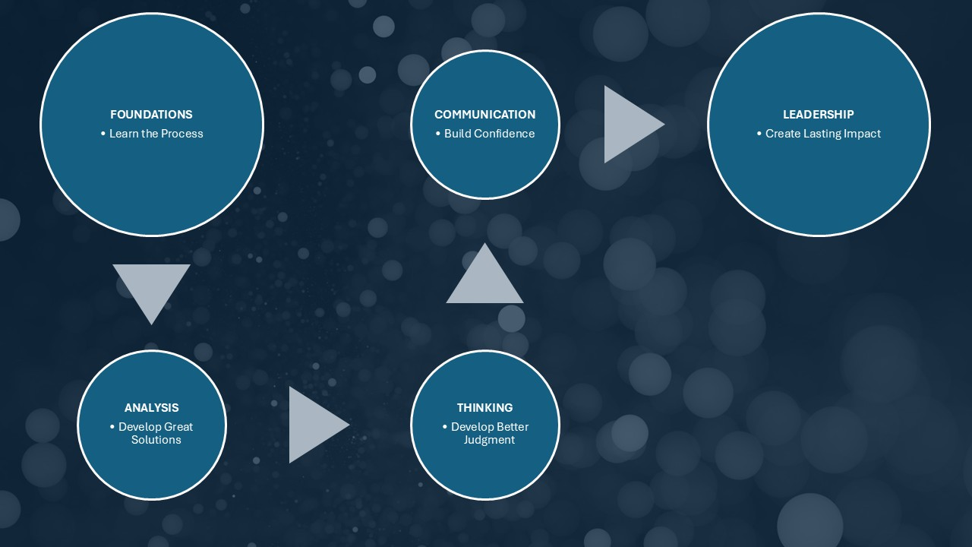
Decipher → Analyse → Develop → Decide → Recommend → Implement → Measure → Communicate
Rather than treating these as isolated steps, you will learn how they connect into an iterative process of critical thinking. You will learn how to ask better questions, transform information into insights, evaluate alternatives objectively, build realistic implementation plans, and communicate recommendations that judges and future employers can trust.
But this manual is about more than winning competitions. The habits developed through case solving are the same habits that distinguish effective managers, consultants, entrepreneurs, engineers, healthcare leaders, and public servants. The ability to analyse uncertainty, make informed decisions, justify recommendations with evidence, collaborate under pressure, and communicate clearly is a set of professional skills that extend far beyond the competition weekend.
That is why the Discover Your MAD Skills Masterclass series focusesfocused on understanding the case-solving process, communicating recommendations effectively, financial analysis, and topics common at top international case competitions. Together, they provided a structured approach to analysing business problems, developing judgmentevidence-based ratherrecommendations, thanand memorisation.presenting the solution with clarity and confidence. Those are essential skills. However, outstanding case competitors quickly discover that possessing a collection of frameworks is not enough.
· KnowledgeMany isteams important.know the same analytical models.
· FrameworksMany areteams valuable.learn the same financial tools.
· FinancialMany analysisteams matters.understand the same presentation structures.
ButYet nonecompetition ofresults thosevary thingsdramatically. createsWhy? value unless you know when to use them, why they matter, and how they fit together. As you work through this manual, I encourage you to resistBecause the temptationstrongest toteams searchthink fordifferently.
· orThey formulas.recognise Instead,patterns practicemore askingquickly.
· They ask better questions.
· They identify insights that others overlook.
· They connect ideas across disciplines.
· They make decisions despite uncertainty.
Most importantly, they understand that frameworks are tools, not answers. This manual is about developing those ways of thinking.
Beyond Memorising Frameworks
One of the most common misconceptions in business education is that successful problem-solving comes from selecting the "right" framework. Frameworks certainly matter.
· They provide structure.
· They help organise information.
· They reduce the risk of overlooking important issues.
But no framework can replace thoughtful analysis. Frameworks do not generate insights. People do. Throughout this manual, you will learn how to use frameworks as thinking tools rather than checklists.
Instead of asking, Challenge"Which yourframework assumptions.should I use?" you will begin asking, "What is this problem really asking me to understand?" That shift represents one of the most important milestones in becoming an outstanding case solver.
The Discover Your MAD Skills Philosophy
At the heart of Discover Your MAD Skills is a simple belief:
Great case solvers are not distinguished by what they know. They are distinguished by how they think.
· ReflectKnowledge on your decisions. changes.
· LearnIndustries from feedback. evolve.
· BecomeTechnologies comfortableemerge.
· uncertainty.Business models transform.
ThoseThe ability to think critically, creatively, strategically, and ethically remains valuable regardless of how the business environment changes. That is why this manual focuses less on memorising content and more on developing adaptable thinking skills.
Deciphering Cases
The Deciphering Cases series has always encouraged competitors to look beyond the obvious. Cases rarely present the real problem on the first page.
· Organisations often describe symptoms rather than causes.
· Customers rarely explain their underlying motivations directly.
· Data alone rarely provides answers.
Outstanding competitors learn to decipher.
· They identify hidden assumptions.
· They question conventional wisdom.
· They search for patterns.
· They combine evidence with judgment.
This manual expands that philosophy by introducing the thinking habits that consistently separate good teams from exceptional ones.
What You Will Learn
The chapters that follow explore the thinking skills used by effective business leaders and consistently successful case competition teams. You will dolearn morehow to:
- think strategically rather than react tactically
- understand organisations as interconnected systems
- strengthen analytical reasoning
- generate creative and innovative alternatives
- recognise ethical implications in complex decisions
- make sound decisions despite uncertainty
- communicate insights through structured problem solving
- apply practical tools that support better thinking
Together, these chapters form a toolkit for approaching unfamiliar problems with confidence and discipline.
A Different Way to improveUse This Manual
Unlike a reference book filled with isolated frameworks, this manual is designed to be experienced as an integrated learning journey. The thinking skills introduced in each chapter build on one another. You will notice recurring themes:
- asking better questions before seeking answers
- identifying root causes rather than symptoms
- balancing analysis with judgment
- recognising trade-offs instead of searching for perfect solutions
- remaining curious throughout the problem-solving process
These are the habits of experienced decision-makers. As you work through the chapters, resist the temptation to memorise every framework. Instead, practice applying them to different cases, industries, and situations. The goal is not to become an expert in frameworks. The goal is to become an expert thinker.
Your Journey Continues
By opening this manual, you have already demonstrated a commitment to improving your case-solvingskills abilityas thana memorisingcase solver. That journey does not end with mastering another framework everor could.adding Theanother goaltool to your toolkit. It continues every time you challenge an assumption, ask a better question, reconsider a recommendation, or learn from feedback. Great case competitors are lifelong learners. Great leaders are too.
As you work through this manual, remember that the objective is not simply to solve more cases. The goalIt is to becomedevelop thea kindway of thinkerthinking whothat canwill solvehelp unfamiliaryou problemsnavigate uncertainty, communicate with confidence, clarity, and soundcreate judgment.value That'slong whatafter greatyour casefinal solverscompetition andhas greatended. leadersWelcome do.to the next stage of your Discover Your MAD Skills journey.
The Evolution of a Case Solver