
Introduction
Introduction
Developing the Mind of a Great Case Solver
"Frameworks don't solve cases. People do."
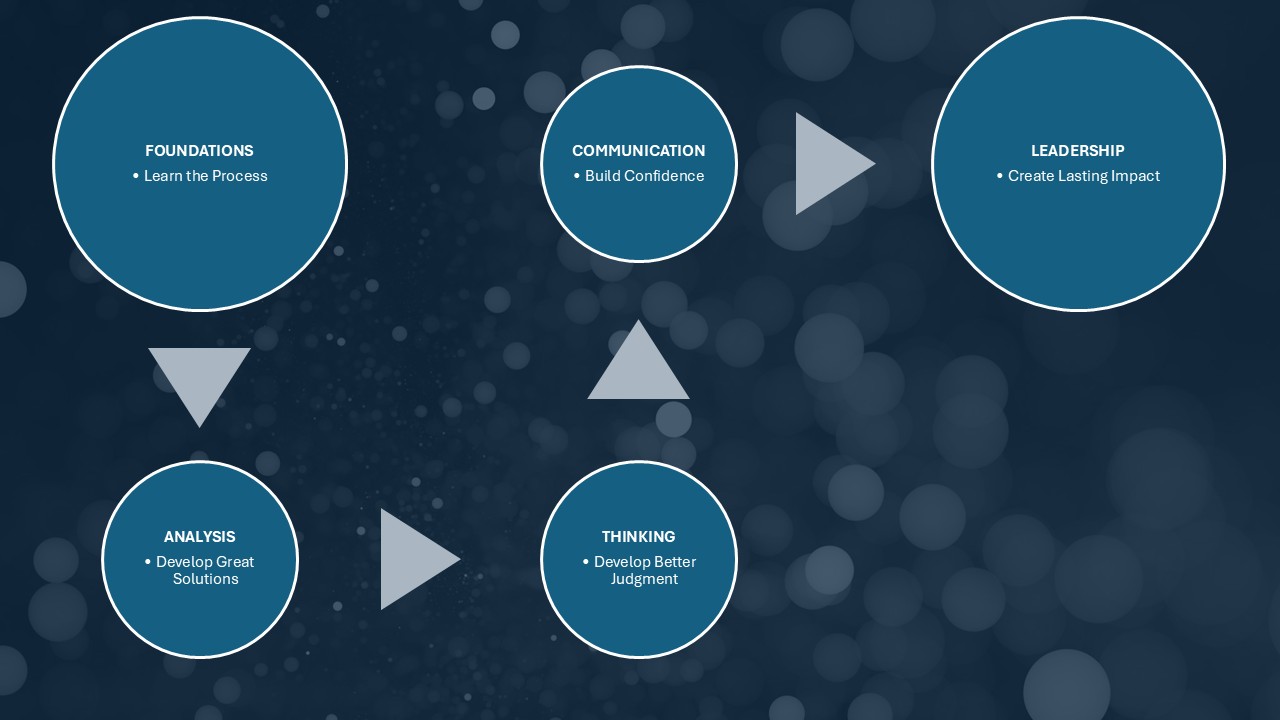
The first two manuals in the Discover Your Mad Skills Masterclass focused on understanding the case-solving process and communicating recommendations effectively. Together, they provided a structured approach for analysing business problems, developing evidence-based recommendations, and presenting the solution with clarity and confidence.
Those are essential skills. However, outstanding case competitors quickly discover that possessing a collection of frameworks is not enough.
- Many teams know the same analytical models.
- Many teams learn the same financial tools.
- Many teams understand the same presentation structures.
Yet competition results vary dramatically. Why? Because the strongest teams think differently.
- They recognise patterns more quickly.
- They ask better questions.
- They identify insights that others overlook.
- They connect ideas across disciplines.
- They make decisions despite uncertainty.
Most importantly, they understand that frameworks are tools, not answers. This manual is about developing those ways of thinking.
Beyond Memorising Frameworks
One of the most common misconceptions in business education is that successful problem solving comes from selecting the "right" framework. Frameworks certainly matter.
- They provide structure.
- They help organise information.
- They reduce the risk of overlooking important issues.
But no framework can replace thoughtful analysis. Frameworks do not generate insights. People do. Throughout this manual, you will learn how to use frameworks as thinking tools rather than checklists.
Instead of asking, "Which framework should I use?" you will begin asking, "What is this problem really asking me to understand?" That shift represents one of the most important milestones in becoming an outstanding case solver.
The Discover Your Mad Skills Philosophy
At the heart of Discover Your Mad Skills is a simple belief:
Great case solvers are not distinguished by what they know. They are distinguished by how they think.
- Knowledge changes.
- Industries evolve.
- Technologies emerge.
- Business models transform.
The ability to think critically, creatively, strategically, and ethically remains valuable regardless of how the business environment changes. That is why this manual focuses less on memorising content and more on developing adaptable thinking skills.
Deciphering Cases
The Deciphering Cases series has always encouraged competitors to look beyond the obvious. Cases rarely present the real problem on the first page.
- Organisations often describe symptoms rather than causes.
- Customers rarely explain their underlying motivations directly.
- Data alone rarely provides answers.
Outstanding competitors learn to decipher.
This manual expands that philosophy by introducing the thinking habits that consistently separate good teams from exceptional ones.
What You Will Learn
The chapters that follow explore the thinking skills used by effective business leaders and consistently successful case competition teams. You will learn how to:
-
think strategically rather than react tactically
-
understand organisations as interconnected systems
-
strengthen analytical reasoning
-
generate creative and innovative alternatives
-
recognise ethical implications in complex decisions
-
make sound decisions despite uncertainty
-
communicate insights through structured problem solving
-
apply practical tools that support better thinking
Together, these chapters form a toolkit for approaching unfamiliar problems with confidence and discipline.
A Different Way to Use This Manual
Unlike a reference book filled with isolated frameworks, this manual is designed to be experienced as an integrated learning journey. The thinking skills introduced in each chapter build on one another. You will notice recurring themes:
-
asking better questions before seeking answers
-
identifying root causes rather than symptoms
-
balancing analysis with judgment
-
recognising trade-offs instead of searching for perfect solutions
-
remaining curious throughout the problem-solving process
These are the habits of experienced decision-makers. As you work through the chapters, resist the temptation to memorise every framework. Instead, practice applying them to different cases, industries, and situations. The goal is not to become an expert in frameworks. The goal is to become an expert thinker.
Your Journey Continues
By opening this manual, you have already demonstrated a commitment to improving your skills as a case solver. That journey does not end with mastering another framework or adding another tool to your toolkit. It continues every time you challenge an assumption, ask a better question, reconsider a recommendation, or learn from feedback.
Great case competitors are lifelong learners. Great leaders are too.
As you work through this manual, remember that the objective is not simply to solve more cases. It is to develop a way of thinking that will help you navigate uncertainty, communicate with confidence, and create value long after your final competition has ended. Welcome to the next stage of your Discover Your Mad Skills journey.
The Evolution of a Case Solver
No Comments