
Cover
Emeritus Professor | Coach & Mentor to Aspiring Professionals | Helping the Next Generation Discover Their “Mad Skills”
© 2026 Discover Your Mad Skills Toolkit
Series Preface
This series of manuals represents an attempt to capture and organise more than 20 years of experience coaching case-solving teams at regional, national, and international competitions.
Over those two decades, I have had the opportunity to coach hundreds of teams, work with students from a wide range of programs and backgrounds and observe what separates teams that simply solve a case from those that solve it exceptionally well. I have also learned a great deal through teaching in the classroom, judging competitions, mentoring students, and, perhaps most importantly, watching teams succeed, struggle, recover, and improve.
Much of what I have learned over those years originally existed in different forms: lecture materials, coaching notes, presentation slides, Excel models, examples, exercises, competition experiences, and conversations with students. These manuals bring those resources together into a more organised and accessible system.
I have used ChatGPT as a tool to help compile, organise, refine, and structure many of the resources I have developed over the years. The ideas, examples, frameworks, approaches, and experiences reflected in these manuals are grounded in that accumulated body of work and in the lessons I have learned through coaching and teaching. The result is a series of five manuals designed to support the development of case-solving skills from the fundamentals through more advanced applications.
The First Two Manuals: Getting Started
The first two manuals are designed to provide a relatively quick introduction to the case-solving process. Their purpose is to help students and new teams get up and running.
The first manual introduces the overall case-solving process from deciphering the case and understanding the problem through analysis, alternatives, recommendations, and implementation.
The second manual focuses on communicating that analysis. A great solution is only valuable if a team can communicate it clearly and persuasively. This manual therefore explores the skills required to turn analysis into a compelling presentation and deliver the presentation effectively. These first two manuals provide the foundation. They are designed to answer the question:
"What do we need to know to start solving and presenting cases effectively?"
The Last Three Manuals: Going Deeper
The final three manuals take a deeper dive into the case-solving process. Rather than simply introducing the steps, they explore the tools, techniques, and specialised skills that can strengthen the quality of the analysis and the decisions that emerge from it.
The third manual expands the toolkit to cover additional analytical and case-solving topics. It offers a deeper exploration of various thinking tools and approaches to help teams understand organisations, industries, markets, customers, stakeholders, and strategic choices. This progression helps teams move from insights to solutions and effectively turn their strategies into actionable steps. Additionally, it addresses the skills necessary to engage and persuade the audience to win the room.
The fourth manual focuses on financial analysis and Excel mastery. It explores how financial information can be used to understand the current situation, evaluate alternatives, model recommendations, assess investments, test assumptions, and turn numbers into meaningful insights.
The fifth manual moves beyond the traditional business case into special topics and more complex decision environments. It explores areas where financial and strategic analysis alone may not tell the whole story, including sustainability, ethics, stakeholder considerations, social enterprises, not-for-profits, implicit bias, and complex trade-offs.
Together, these final three manuals are intended to answer a different question:
"How can we develop the depth of analysis and judgment required to solve more complex cases?"
More Than a Collection of Frameworks
One of the lessons I have learned through coaching is that successful case solving is not about knowing all the frameworks. It is about knowing which questions need to be answered and which tools can help answer them.
- A framework is useful when it helps a team see something it might otherwise miss.
- A financial model is useful when it helps a team determine whether a recommendation is viable.
- A stakeholder analysis is useful when it reveals an important conflict or implementation risk.
- A valuation model is useful when it helps determine an opportunity's worth.
- A sensitivity analysis is useful when it shows whether a recommendation remains attractive when assumptions change.
The objective is therefore not to use every tool available. It is to develop the judgment to know when a tool is useful and when it is not. Throughout these manuals, that principle is fundamental:
The goal is not to collect tools. The goal is to develop judgment.
A Record of What I Have Learned
These manuals are also personal in an important way. They represent the lessons I have accumulated through more than two decades of coaching and working with case-solving teams. Some lessons came from podium finishes and successful competitions. Others came from teams that struggled. Some came from seeing a particular approach work exceptionally well. Others came from watching a team make a mistake and realising that there was a better way. That is one of the things I value most about case competitions. Every case, every team, every judge, and every competition provides another opportunity to learn.
The manuals are an attempt to capture some of those lessons so that they can be shared more broadly. I hope that they will help students avoid some of the mistakes I have seen over the years, develop better habits more quickly, and ultimately become more confident and capable case solvers.
How to Use the Series
The five manuals are designed to work together, but they do not have to be read from beginning to end every time.
- Use the first two manuals to understand the overall process.
- Use the final three manuals as deeper reference guides when you need to strengthen a particular skill, explore a specific analytical tool, or prepare for a more complex case.
- Return to individual chapters when you are practising.
- Use the examples when you need to see how a concept can be applied.
- Use the checklists when you are preparing for competition.
- Most importantly, take the ideas into your practice environment and test them.
Case solving is a skill. Like any skill, it improves through repetition, reflection, feedback, and deliberate practice. These manuals are intended to support that process.
Finally
I have learned an enormous amount from the students and teams I have had the privilege of coaching over the past 20-plus years.
- Their questions have challenged my thinking.
- Their mistakes have taught me what needs to be explained differently.
- Their successes have shown me what is possible.
- Their persistence has reinforced one of the most important lessons of case competitions:
You don't become a great case solver by knowing everything. You become one by learning how to think, how to adapt, and how to make good decisions when you don't have all the answers. That is ultimately what these manuals are designed to help you do.
Welcome to the Discover Your Mad Skills Masterclass.
Decipher the case. Develop the skills. Turn those skills into decisions. Win the podium.
Part I Introduction
Every business case begins with uncertainty. You are handed a situation that is incomplete, ambiguous, and often deliberately complex. Some information is important. Some is distracting. Some facts point in different directions. Your challenge is not simply to find an answer—it is to determine which questions matter, what the evidence really means, and what decision will create the greatest value.
That is the skill this manual is designed to develop.
Many students begin preparing for case competitions by memorising frameworks. They collect SWOT analyses, Porter's Five Forces, PESTLE, Value Chains, Business Model Canvases, and dozens of other tools, hoping that somewhere inside those models is the formula for solving every case.
There isn't one. Frameworks don't solve cases. People do.
The best competitors don't ask, "Which framework should we use?" They ask, "What problem are we trying to solve?" Only then do they choose the tools that will help them answer that question. That shift in thinking is what separates competent competitors from exceptional ones.
Throughout this manual, you will see one idea repeated again and again:
Don't start with a framework. Start with understanding the case.
Every organisation is different. Every industry is different. Every decision-maker faces different objectives, constraints, stakeholders, risks, and opportunities. The strongest teams recognise these differences early. They decipher the case before they analyse it. They identify the real problem before generating solutions. They distinguish symptoms from root causes. They develop alternatives that emerge from evidence rather than preference. And when they finally make a recommendation, it feels like the logical conclusion of everything that came before.
This manual introduces a complete case-solving architecture built around that philosophy:
Decipher → Analyze → Develop → Decide → Recommend → Implement → Measure → Communicate
Rather than treating these as isolated steps, you will learn how they connect into an iterative process of critical thinking. You will discover how to ask better questions, transform information into insights, evaluate alternatives objectively, build realistic implementation plans, and communicate recommendations that judges—and future employers—can trust.
But this manual is about more than winning competitions. The habits developed through case solving are the same habits that distinguish effective managers, consultants, entrepreneurs, engineers, healthcare leaders, and public servants. The ability to analyse uncertainty, make informed decisions, justify recommendations with evidence, collaborate under pressure, and communicate clearly are professional skills that extend far beyond competition weekend.
That is why the Discover Your Mad Skills series is built around developing judgment rather than memorisation.
- Knowledge is important.
- Frameworks are valuable.
- Financial analysis matters.
But none of those things creates value unless you know when to use them, why they matter, and how they fit together.
As you work through this manual, I encourage you to resist the temptation to search for shortcuts or formulas. Instead, practice asking better questions. Challenge your assumptions. Reflect on your decisions. Learn from feedback. Become comfortable with uncertainty. Those habits will do more to improve your case-solving ability than memorising another framework ever could.
The goal is not simply to solve more cases. The goal is to become the kind of thinker who can solve unfamiliar problems with confidence, clarity, and sound judgment. Because that's what great case solvers and great leaders do.
About the Author
Cam Welsh
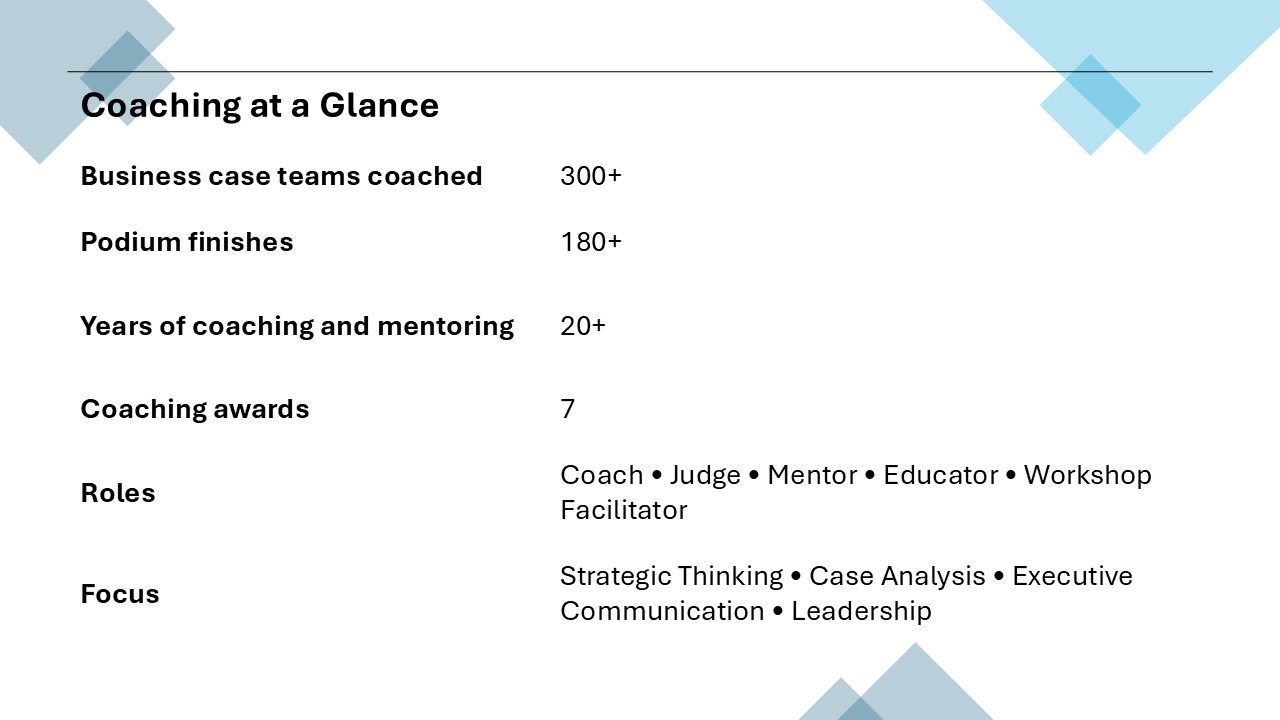
Cam Welsh is an award-winning educator, executive coach, and one of Canada's most experienced case competition coaches. Over the past two decades, he has coached and mentored more than 300 business case competition teams at the undergraduate, graduate, and interdisciplinary levels, helping students achieve more than 180 podium finishes at regional, national, and international competitions.
Throughout his coaching career, Cam has worked with students competing in many of the world's leading case competitions, while also serving as a judge, mentor, and workshop facilitator for universities, organisations, and innovation challenges. These experiences have provided a unique perspective on what distinguishes exceptional teams from those that perform well.
His coaching philosophy is built on a simple belief:
Great case solvers are developed through deliberate practice, thoughtful reflection, and the courage to embrace difficult challenges.
Rather than focusing solely on competition results, Cam emphasises building the habits of critical thinking, strategic decision-making, effective communication, and collaborative leadership that prepare students for long-term professional success.
The Discover Your Mad Skills Philosophy
The Discover Your Mad Skills series was created to help students move beyond memorising frameworks and toward developing the mindset of outstanding business professionals.
While many resources focus on analytical models or presentation techniques in isolation, this series integrates the complete case-solving process—from defining problems and developing strategy to communicating recommendations with confidence and responding effectively under pressure.
At the heart of the series is the belief that confidence is not something people are born with. Confidence is built. It grows through preparation, repeated practice, constructive feedback, and learning to recover from setbacks. Those experiences help students discover abilities they often did not realise they possessed. That journey is what Discover Your Mad Skills is all about.
Deciphering Cases
Cam is also the author of the Deciphering Cases series, which explores the deeper thinking behind successful case solving. Rather than presenting frameworks as formulas, Deciphering Cases encourages competitors to ask better questions, challenge assumptions, identify meaningful insights, and think more strategically about complex business problems. The ideas developed in those articles have influenced the philosophy and structure of this masterclass series, encouraging readers to become thoughtful problem solvers rather than simply competent users of frameworks.
Beyond the Competition
Although these manuals were written for case competition teams, the skills they develop extend far beyond competition weekend. Strategic thinking, financial reasoning, executive communication, leadership, teamwork, decision-making under uncertainty, and resilience are essential capabilities in every profession.
Whether readers pursue careers in consulting, entrepreneurship, engineering, finance, marketing, healthcare, public service, or the non-profit sector, the principles explored throughout these manuals are designed to support better decisions and stronger leadership. Ultimately, the goal of this series is not simply to help readers win more case competitions. It is to help them become more confident thinkers, more effective communicators, and more capable leaders.
Connect and Continue Learning
The Discover Your Mad Skills journey extends beyond these manuals through a growing collection of videos, articles, and learning resources. Continue your learning by exploring:
-
Discover Your Mad Skills Masterclass on YouTube
-
Innovatank TV, where the complete masterclass series is also available for learners in regions where YouTube is unavailable
-
Deciphering Cases on Patreon, featuring articles, practical insights, and coaching resources for developing stronger case-solving skills
Learning is not a destination; it is a continuous process of asking better questions, seeking deeper understanding, and applying those insights to increasingly complex challenges. Thank you for joining me on this journey. I hope these manuals help you discover not only how to solve cases more effectively, but also the confidence, curiosity, and leadership skills that will serve you throughout your career.
How to Use This Manual
Business case-solving competitions are not won by knowing the most frameworks.
They are won by knowing
which questions to ask, which problems to solve, which tools to use, which ideas to pursue, and how to turn all of that thinking into a clear recommendation that a judge can believe.
This manual is designed to help you build those skills.
The goal is not to memorise a formula for solving every case. No such formula exists.
Instead, you will learn a repeatable process for:
DECIPHER → ANALYZE → DEVELOP → DECIDE → RECOMMEND → IMPLEMENT → COMMUNICATE
The process provides structure without taking away the judgment, creativity, and critical thinking that make case competitions valuable.
Before you decide which framework to use, you need to understand what kind of case you are facing. The characteristics of the case should influence your questions, your analysis, your alternatives, and ultimately your recommendation.
The better you become at deciphering cases, the less you will rely on frameworks as recipes and the more you will use them as strategic tools.
Note: This manual is designed to work alongside the instructional Masterclass videos available on the Mad Skills Masterclass YouTube channel. For those in regions where YouTube is unavailable, the videos are also available through Innovatank TV. This first Masterclass Manual includes references to several videos from Masterclass 2, which are incorporated to reinforce key concepts and provide additional instruction. The complete series of Deciphering Cases posts is also available through Discover Your Mad Skills on Patreon, providing additional insights, examples, and perspectives to help you develop your case-solving skills.